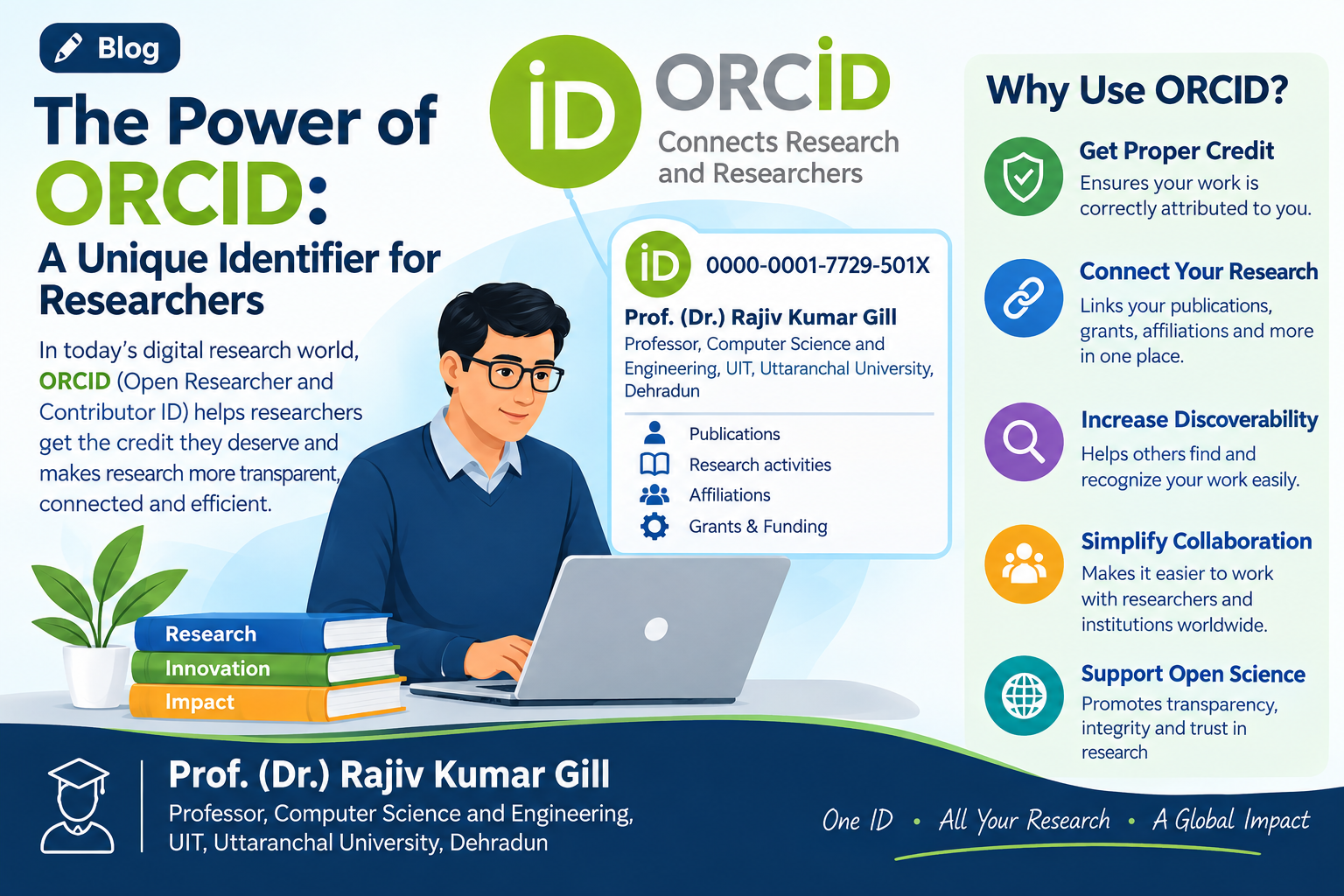
Author: Prof. (Dr.) Rajiv Kumar Gill
Designation: Professor, Computer Science and Engineering
Affiliation: Uttaranchal Institute of Technology (UIT), Uttaranchal University, Dehradun, India
ORCID iD: 0000-0001-7729-501X
Introduction
In today's rapidly evolving academic and digital research environment, researchers are expected not only to produce high-quality scholarly work but also to ensure that their contributions are accurately identified, accessible, and recognized worldwide. The growth of digital publishing, interdisciplinary research, international collaboration, and online scholarly databases has created new opportunities for researchers. However, it has also introduced challenges in maintaining a consistent academic identity across multiple platforms.
One important challenge is author identification. Researchers may share similar names, publish under different name formats, change institutional affiliations, or work across several disciplines during their careers. These variations can make it difficult to distinguish one researcher from another and accurately associate publications, projects, and other scholarly contributions with the correct individual.
The Open Researcher and Contributor ID (ORCID) provides an effective solution to this problem. ORCID offers a unique, persistent digital identifier that connects researchers with their scholarly contributions, professional affiliations, and research activities. It helps establish a consistent academic identity that remains with the researcher throughout their professional career, regardless of changes in institution, research field, or geographical location.
For faculty members, research scholars, postgraduate students, and academic professionals, ORCID is an important component of responsible research communication. Its effective use can simplify research administration, improve the discoverability of scholarly outputs, and support reliable information exchange among publishers, universities, funding agencies, and research databases.
1. What Is ORCID?
ORCID is an international, community-driven, not-for-profit initiative that provides researchers and other contributors with a unique digital identifier. Its primary purpose is to establish reliable connections between individuals and their scholarly contributions. Researchers can register for an ORCID iD free of charge and maintain a personal record containing relevant information about their academic and professional activities.
An ORCID iD consists of 16 digits, conventionally displayed in four groups separated by hyphens. For example, my ORCID identifier is:
https://orcid.org/0000-0001-7729-501X
This identifier distinguishes my academic identity from those of other researchers, including individuals who may have similar names.
An ORCID record can contain information about publications, employment, education, research funding, professional distinctions, peer-review activities, and other research-related contributions. Researchers control their records and can determine how individual items are shared.
It is important to understand that ORCID is more than a digital identification number. It functions as a connection point between researchers and the broader scholarly communication ecosystem, enabling compatible systems to exchange research information with appropriate permissions.
Official resource: ORCID — What Is ORCID?
2. Why Do Researchers Need ORCID?
Research activities are distributed across numerous digital platforms. A single researcher might publish journal articles, contribute to conference proceedings, write books, supervise research scholars, participate in funded projects, and collaborate with institutions in different countries.
Managing these activities across multiple platforms can create inconsistencies. For example, a researcher may publish one paper using a full name and another using initials. A database might incorrectly associate a publication with a different author who has a similar name. Changes in institutional affiliation may also make it difficult to maintain a complete record of scholarly achievements.
ORCID helps address these challenges by providing a persistent identifier that remains associated with the researcher throughout their career.
Its importance can be understood through several key benefits:
- Unique identification: Distinguishes researchers with similar or identical names.
- Accurate attribution: Helps connect scholarly outputs with their appropriate authors.
- Improved discoverability: Makes it easier for others to find a researcher's professional record and linked contributions.
- Career continuity: Maintains a consistent identifier across institutions, countries, and research disciplines.
- Reduced administrative work: Supports the reuse and exchange of information across compatible academic systems.
- Research connectivity: Links researchers with publications, affiliations, grants, and other professional activities.
These advantages are valuable for early-career researchers as well as established academics with extensive publication records.
3. Major Applications of ORCID in Academic Research
3.1 Accurate Attribution of Research Publications
One of the most significant applications of ORCID is the identification of authors in scholarly publications. Researchers frequently submit articles to international journals, conferences, and edited volumes. During submission, publishers may request an authenticated ORCID iD to establish a reliable connection between the author and the manuscript.
When supported by the publishing platform, the identifier can be included in publication metadata and associated with the researcher's ORCID record. Compatible services may also update the record with information about the published work.
This process helps researchers maintain a more consistent publication history and reduces the risk of confusion caused by variations in author names.
For instance, a computer science researcher publishing in machine learning, data science, and evolutionary computation can use the same ORCID iD across all these areas. The identifier provides continuity even when publications appear in different journals, conference proceedings, or repositories.
Nevertheless, ORCID does not automatically guarantee that every publication is correctly indexed or attributed. Researchers should periodically review their records and correct missing or inaccurate entries.
3.2 Improving Research Visibility and Discoverability
Research visibility is an important consideration for academics seeking to communicate their findings to a wider audience. Publications may be distributed across journal websites, institutional repositories, bibliographic databases, and other scholarly platforms.
ORCID provides a central point through which researchers can connect information about their academic contributions. When a record is complete and appropriately configured for public visibility, other researchers, editors, prospective collaborators, and institutions can more easily discover relevant information.
A well-maintained ORCID profile can include publication details, research interests, educational background, professional appointments, and funding information. This helps create a clearer picture of a researcher's academic journey.
Researchers should therefore include their ORCID iD on institutional profile pages, personal websites, email signatures, research presentations, and other professional materials.
However, ORCID should not be viewed as a ranking system. Registering for an identifier does not automatically increase citations, improve journal acceptance rates, or guarantee greater research impact. Its principal value lies in identification, reliable connections, and improved information management.
3.3 Connecting Research with Institutional Affiliations
Academic affiliations are an important part of a researcher's professional identity. Researchers may change universities, undertake visiting appointments, or collaborate with multiple institutions during their careers.
ORCID allows employment and education information to be associated with a researcher's record. This helps establish connections between individuals and the institutions with which they are professionally affiliated.
For university faculty members, maintaining accurate affiliation information is especially useful for institutional websites, research profiles, project documentation, and scholarly communication.
Universities can also benefit from encouraging faculty members and research scholars to maintain ORCID records. Where appropriate integrations are available, institutional systems can exchange information with ORCID, helping reduce repetitive data entry and improving the consistency of academic records.
Researchers should ensure that their current designation and institutional affiliation are accurate. Information that has been independently asserted by a trusted organization can provide additional evidence of its source, although the absence of such verification does not automatically make a record invalid.
3.4 Supporting Research Funding and Grant Applications
Research funding is essential for advancing scientific knowledge, developing new technologies, and addressing societal challenges. Funding applications frequently require information about a researcher's qualifications, previous publications, institutional affiliations, and research experience.
ORCID can support this process by connecting researchers with their funding information and other professional contributions. Some compatible funding systems can use authenticated ORCID connections to retrieve information or reduce repetitive form filling.
For principal investigators and co-investigators, a maintained record can help organize information about research grants, related publications, and professional activities.
For example, researchers applying for grants in artificial intelligence, sustainable development, healthcare technology, or computational optimization can use ORCID as part of their broader research-information management practices.
ORCID does not replace the detailed documentation required by funding agencies. Applicants must still provide accurate proposals, budgets, project descriptions, and other requested evidence. Its role is to help connect and reuse relevant researcher information where supported.
3.5 Facilitating International Research Collaboration
Contemporary research increasingly involves collaboration across institutions, disciplines, and national boundaries. International research teams need reliable ways to identify contributors, connect professional profiles, and coordinate scholarly activities.
ORCID supports collaboration by giving each participating researcher a persistent identifier. When researchers use their identifiers in manuscripts, grant applications, and compatible research platforms, it becomes easier to associate contributions with the correct individuals.
This is particularly valuable for interdisciplinary projects involving computer science, engineering, healthcare, environmental science, management, and social sciences.
ORCID can also help research teams distinguish contributors who share similar names and maintain consistent identification across collaborative outputs.
Although an ORCID iD does not itself create collaborations or establish the quality of a researcher's work, it can improve the reliability of the information used to identify potential collaborators and document joint achievements.
4. ORCID for PhD Scholars and Early-Career Researchers
For doctoral scholars and early-career researchers, developing a credible academic identity is an important step toward a successful research career. At this stage, researchers may be preparing their first journal papers, presenting conference findings, applying for fellowships, and exploring doctoral or postdoctoral opportunities.
Creating an ORCID record early helps establish a consistent identifier from the beginning of their academic journey.
Students can gradually build their records by adding relevant publications, educational qualifications, research activities, and other appropriate contributions. As their careers progress, the same identifier can continue to connect their work across institutions and disciplines.
Supervisors and universities should encourage research scholars to:
- Register for an ORCID iD using the official ORCID website.
- Complete the profile with accurate personal and academic information.
- Add published works and other eligible research contributions.
- Use the identifier during manuscript submissions and research applications.
- Connect compatible institutional and publishing systems securely.
- Review the record regularly to maintain accuracy.
These practices encourage good research-information management from the beginning of a scholar's career.
5. Integrating ORCID with Research Databases and Publishing Platforms
ORCID becomes particularly useful when it is connected with other systems involved in scholarly communication. Its integration capabilities allow compatible publishers, repositories, institutions, and funders to exchange information with a researcher's record.
For example, Crossref and DataCite provide infrastructure for registering and managing persistent identifiers for scholarly outputs. Depending on the available integration and permissions, publication information associated with these services may be linked to ORCID records.
Similarly, journal submission platforms may allow authors to authenticate their ORCID iDs and use them throughout the publication workflow. Institutional repositories can also connect research outputs with researcher profiles.
It is important to distinguish ORCID from other scholarly databases and identifiers:
- ORCID: Identifies the researcher.
- DOI: Identifies a specific digital object, such as a journal article or dataset.
- Scopus Author ID: Identifies an author within the Scopus database.
- Web of Science Researcher Profile and identifier services: Help organize author information and scholarly activity within the Web of Science ecosystem.
- Google Scholar profile: Provides a searchable profile of publications and associated citation information.
These services serve different purposes and can complement one another. ORCID is not a substitute for Scopus, Web of Science, or Google Scholar. Instead, it provides a persistent researcher identifier that can connect information across compatible systems.
Researchers should also remember that the availability and accuracy of data exchange depend on the individual platform, its integration capabilities, and the permissions granted by the researcher.
6. ORCID and Research Integrity
Research integrity depends on accurate attribution, transparent reporting, responsible authorship, and trustworthy scholarly communication. ORCID can contribute to these goals by supporting more reliable connections between researchers and their professional activities.
When publishers and institutions collect authenticated ORCID iDs, they can establish a stronger connection between an individual and the scholarly contributions associated with that person.
A researcher can also use their ORCID record to maintain a structured overview of publications, affiliations, funding, and other activities. This can be helpful when preparing academic profiles, reporting project outcomes, or reviewing research achievements.
However, ORCID should not be interpreted as a certificate of research quality or ethical conduct. The presence of an ORCID iD does not independently verify every claim in a profile, guarantee that a publication is reputable, or establish that a research project complies with ethical standards.
Responsible use requires researchers to maintain accurate information, verify imported records, respect co-authors' contributions, and follow applicable institutional and publication ethics policies.
7. Privacy, Security, and Researcher Control
An important feature of ORCID is that researchers retain control over their records and the visibility of individual items. Information can be managed according to the available visibility settings, allowing researchers to decide what is publicly available and what is shared more restrictively.
Before connecting ORCID to an external platform, researchers should authenticate through the official ORCID sign-in process and review the permissions requested. They should understand whether the connected service will be able to read information, add new information, or perform other permitted actions.
Researchers should also protect their account credentials and maintain access to their account by keeping appropriate email addresses up to date.
A practical approach to account management includes:
- Reviewing profile information periodically.
- Checking publication titles, author lists, and persistent links.
- Reviewing visibility settings for individual record items.
- Connecting only with legitimate services.
- Examining authorization requests before granting access.
- Correcting duplicate or incorrectly associated research outputs.
These practices help researchers benefit from ORCID while maintaining control over their professional information.
8. Best Practices for Maintaining an Effective ORCID Profile
Simply registering for an ORCID iD is only the first step. The real benefit comes from maintaining an accurate, complete, and useful record.
Researchers should consider the following recommendations.
First, complete the profile. Add relevant biographical information, professional affiliations, education, and research interests. Ensure that the information is consistent with official institutional records.
Second, maintain publication information. Add journal articles, conference papers, books, chapters, datasets, and other eligible outputs. Use available trusted integrations where possible and verify the imported metadata.
Third, use ORCID consistently. Include the identifier in manuscript submissions, grant applications, institutional profiles, and professional email signatures.
Fourth, connect compatible systems. Use authenticated connections with appropriate publishers, repositories, and institutional services to facilitate information exchange.
Fifth, review the record regularly. Check that new publications are correctly attributed and that outdated affiliations or incorrect entries are addressed.
Sixth, manage privacy settings. Make information public when discoverability is desired, while keeping other information private or restricted where appropriate.
Finally, encourage institutional adoption. Universities can promote ORCID awareness through faculty-development programmes, research workshops, doctoral induction sessions, and institutional repository initiatives.
Together, these practices help transform ORCID from a basic identifier into a useful component of a researcher's professional workflow.
9. The Future of ORCID in Digital Research
As scholarly communication becomes increasingly interconnected, persistent identifiers are expected to remain an important part of research infrastructure. Researchers work with publications, datasets, software, grants, peer-review systems, institutional repositories, and emerging digital research tools. Connecting these activities reliably is essential for maintaining accurate research information.
ORCID can support this development by enabling consistent identification and authorized information exchange across compatible systems.
Its relevance extends beyond traditional journal publications. Research increasingly includes software, open datasets, technical reports, interdisciplinary projects, and other outputs that may not fit within conventional publication models.
For computer science and engineering researchers, these developments are particularly significant. Software artifacts, computational methods, datasets, and collaborative research projects can form important parts of a research contribution. Where suitable metadata and integrations are available, ORCID can help associate these activities with their contributors.
The broader objective is to create a more connected and transparent scholarly environment in which research contributions can be identified, linked, and discovered more reliably.
ORCID alone cannot solve every challenge in academic communication. Its effectiveness depends on accurate records, responsible adoption, compatible technical systems, and active participation by researchers and institutions.
Nevertheless, it offers a practical foundation for strengthening digital academic identity and improving the management of research information.
Conclusion
ORCID has become an important resource for researchers seeking to establish a consistent academic identity in an increasingly digital and interconnected research environment. By providing a unique, persistent identifier, it helps distinguish researchers with similar names, connect scholarly contributions, improve discoverability, and facilitate information exchange across compatible publishing and research systems.
Its applications span publication management, institutional affiliations, funding activities, international collaboration, doctoral research, and research administration. For universities, ORCID can support more consistent academic records and reduce repetitive data entry when appropriate integrations are implemented. For individual researchers, it offers a practical way to maintain continuity throughout their professional careers.
However, the effectiveness of ORCID depends on more than registration. Researchers should keep their records accurate, use their identifiers consistently, review permissions carefully, and connect their profiles with trusted services where appropriate.
As academic research continues to evolve, maintaining a reliable digital research identity is an increasingly valuable professional practice. Every faculty member, research scholar, and academic contributor should consider ORCID an integral part of responsible research-information management.
My ORCID iD: https://orcid.org/0000-0001-7729-501X
Author: Prof. (Dr.) Rajiv Kumar Gill
Professor, Computer Science and Engineering
Uttaranchal Institute of Technology (UIT), Uttaranchal University, Dehradun, India
References and Further Reading
- ORCID. What Is ORCID? https://support.orcid.org/hc/en-us/articles/360006973993-What-is-ORCID
- ORCID. What Is an ORCID iD and How Do I Use It? https://support.orcid.org/hc/en-us/articles/360006897334-What-is-an-ORCID-iD-and-how-do-I-use-it
- ORCID. ORCID for Researchers. https://info.orcid.org/researchers/
- ORCID. ORCID and Research Transactions. https://support.orcid.org/hc/en-us/articles/360006971033-ORCID-and-research-transactions
- ORCID. Documentation and Integrations. https://info.orcid.org/documentation/