The Power of ORCID: Transforming Research Visibility, Academic Identity, and Global Collaboration
Author: Prof. (Dr.) Rajiv Kumar GillDesignation: Professor, Computer Science and EngineeringAffiliation: Uttaranchal Institute of Technolog…
SciProfiles: Building Your Academic Identity, Enhancing Research Visibility, and Connecting with the Global Research CommunityAuthor: Prof. (Dr.) Rajiv Kumar Gill Designation: Professor, Computer Science and Engineering…

SciProfiles: Building Your Academic Identity, Enhancing Research Visibility, and Connecting with the Global Research Community
Author: Prof. (Dr.) Rajiv Kumar Gill
Designation: Professor, Computer Science and Engineering
Affiliation: Uttaranchal Institute of Technology (UIT), Uttaranchal University, Dehradun, India
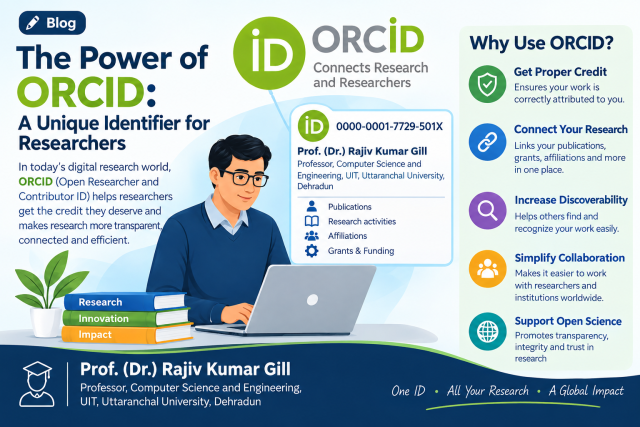
ORCID iD: 0000-0001-7729-501X
Introduction
In the modern academic landscape, research is no longer limited to publishing papers in journals or presenting findings at conferences. Researchers must also communicate their work effectively, establish a credible professional identity, connect with fellow scholars, and make their contributions discoverable to the global scientific community. As digital technologies continue to transform scholarly communication, academic networking platforms have become increasingly important for researchers at every stage of their careers.
One such platform is SciProfiles, an academic social networking platform developed by MDPI to support scholarly communication, research discovery, and collaboration. It provides researchers with an online space to present their academic profiles, showcase their scientific contributions, discover research-related content, and engage with the wider scholarly community. The platform aims to make academic contributions more accessible while encouraging communication among researchers across disciplines and geographical boundaries. https://sciprofiles.com/profile/3041792
For university faculty members, doctoral scholars, research scientists, and early-career academics, SciProfiles offers an opportunity to organize and communicate their professional achievements in a digital environment. A well-maintained academic profile can help readers understand a researcher's interests, explore their publications, and identify potential opportunities for collaboration.
However, establishing an online profile is only the first step. The real value comes from maintaining accurate information, sharing meaningful research, participating responsibly in scholarly discussions, and building professional connections.
This article explores the purpose of SciProfiles, its major applications, its benefits for researchers, and practical strategies for using the platform effectively.
1. What Is SciProfiles?
SciProfiles is an online academic networking platform associated with MDPI. It is designed to help researchers and scholars present their academic contributions and connect with the broader research community.
Unlike a conventional personal webpage that may primarily display a biography and a list of publications, an academic networking platform can bring together several dimensions of a researcher's professional activities. Depending on the information available and the platform's current features, a SciProfiles presence can help communicate publications, research interests, professional contributions, and scholarly interactions.
The platform also supports the discovery and discussion of research. Its broader objective is to facilitate academic communication and make it easier for researchers to find relevant scientific work and connect with colleagues who share similar interests.
Researchers can explore the platform through its official website:
SciProfiles: https://sciprofiles.com/
For academics working in computer science and engineering, SciProfiles can serve as one component of a broader digital research presence, alongside an institutional webpage, ORCID, Google Scholar, Scopus, and other relevant scholarly services.
It is important to understand that these platforms have different purposes. SciProfiles emphasizes academic profiles and networking, while ORCID provides a persistent researcher identifier and bibliographic databases offer their own publication discovery and citation-analysis functions.
2. Why Is an Academic Profile Important?
An academic profile is often one of the first resources consulted by researchers, journal editors, conference organizers, students, and prospective collaborators who want to learn about a scholar's work.
A comprehensive profile helps answer several important questions:
Without an organized online presence, information about a researcher's work may remain scattered across journal websites, institutional pages, repositories, and professional networks.
SciProfiles can help researchers present relevant information within an academic networking environment. This can make it easier for interested readers to explore their work and understand the connections between their research interests and published contributions.
A professional academic profile is particularly valuable when researchers are developing new collaborations, participating in international conferences, applying for research funding, or communicating their expertise to a broader audience.
Nevertheless, profile completeness and online visibility should support research quality rather than replace it. The ultimate value of an academic profile depends on the quality, integrity, and relevance of the work it represents.
3. Major Applications of SciProfiles in Academic Research
3.1 Showcasing Research Publications
Research publications are a central component of academic work. Journal articles, conference papers, book chapters, and other scholarly outputs document the development and dissemination of scientific knowledge.
SciProfiles provides a platform through which researchers can present and discover publication-related information. MDPI has described integrations between SciProfiles and its broader scholarly publishing ecosystem, including the association of publications with researchers' profiles. https://sciprofiles.com/profile/3041792
For a researcher working in computer science and engineering, an organized publication profile can help communicate contributions across several areas, such as artificial intelligence, machine learning, data science, soft computing, optimization, and computational intelligence.
When preparing a profile, researchers should verify that publication titles, author names, publication dates, and other bibliographic details are accurate. They should also check for duplicate records and ensure that their work is attributed appropriately.
Researchers should not assume that every publication will appear automatically or that all external databases synchronize perfectly. Profile information should be reviewed periodically, and missing or inaccurate entries should be corrected through the available platform features.
3.2 Increasing Research Discoverability
Producing research is only one part of the scholarly process; making it discoverable is another.
Research findings may be highly relevant to researchers working in related areas, but potential readers may not encounter them unless they can identify the work through appropriate discovery channels.
Academic networking platforms can help bridge this gap by bringing together researcher information, publication-related content, and scholarly interests. SciProfiles also describes personalized content discovery through recommendations based on research interests and other relevant signals.
For example, a researcher studying machine-learning-based optimization may benefit from discovering researchers working on evolutionary algorithms, swarm intelligence, intelligent systems, or real-world optimization problems.
Such discovery can introduce researchers to relevant publications and potential collaborators. It may also help early-career academics identify research communities aligned with their interests.
However, discoverability does not automatically translate into citations, publication acceptance, or increased research impact. These outcomes depend on many factors, including research quality, relevance, accessibility, and engagement by the scientific community.
3.3 Supporting Academic Networking
Research increasingly depends on collaboration. Many contemporary problems require expertise from multiple disciplines, institutions, and geographical regions.
SciProfiles aims to support communication and networking among researchers. Academic networking can help scholars discover colleagues with related interests, explore each other's contributions, and identify opportunities for intellectual exchange.
For example, a computer science department may be interested in collaborating with researchers working in healthcare, environmental science, management, or electrical engineering. Researchers who clearly communicate their interests and relevant expertise can make it easier for potential collaborators to assess areas of common ground.
Effective networking should focus on meaningful academic engagement rather than simply accumulating connections. Researchers can begin by exploring relevant publications, following developments in their fields, and initiating discussions about specific research questions.
When these interactions lead to genuine intellectual exchange, academic networking can contribute to the development of joint research proposals, interdisciplinary publications, conference activities, and other collaborative initiatives.
3.4 Communicating Research Interests
A clear statement of research interests helps readers understand a scholar's expertise and identify possible connections.
For a researcher in computer science and engineering, these interests might include artificial intelligence, machine learning, data science, soft computing, evolutionary computation, intelligent optimization, and their applications in real-world problems.
A profile should communicate these interests accurately and avoid listing unrelated keywords simply to attract attention.
Researchers can also explain how their interests have developed over time. For instance, work on evolutionary algorithms may lead to research on machine-learning-assisted optimization, while data science projects may inspire interdisciplinary applications in sustainability, healthcare, or engineering.
A coherent description of research interests allows readers to understand both the breadth and direction of a scholar's work.
3.5 Highlighting Broader Academic Contributions
Academic achievements extend beyond journal publications. Faculty members and research scholars contribute to the research ecosystem through peer review, editorial responsibilities, conference organization, mentoring, teaching, research supervision, and scientific discussion.
MDPI's original introduction to SciProfiles described the platform's ambition to recognize contributions beyond publication counts, including reviewing, editing, conference participation, lecturing, and student mentoring.
Recognizing these activities provides a more rounded picture of academic engagement.
For example, a professor who publishes research articles, supervises doctoral students, reviews manuscripts, and organizes academic conferences contributes to research in several complementary ways.
Researchers should document such activities accurately and provide supporting details where appropriate. Claims about editorial roles, awards, invited lectures, and professional responsibilities should be verifiable and should not exaggerate the individual's contribution.
4. SciProfiles for Faculty Members and University Researchers
For university faculty members, an academic profile can support communication with students, research scholars, colleagues, and external research partners.
A faculty member's professional work may include classroom teaching, postgraduate supervision, doctoral research, funded projects, publications, conference participation, and academic administration. An organized digital profile can help communicate the research-related dimensions of this work.
Universities may also benefit when faculty members maintain consistent professional information across institutional webpages and relevant academic platforms. Accurate names, designations, affiliations, and publication records can make it easier to associate scholarly work with the correct institution and researcher.
For a computer science and engineering professor, SciProfiles can be one part of a broader strategy for communicating research in areas such as artificial intelligence, machine learning, data analytics, and intelligent optimization.
Faculty members should coordinate their online information with official university records, particularly when updating their designations, affiliations, or research interests.
A SciProfiles profile does not replace an official university webpage, institutional research repository, or formal record of academic service. Instead, it can complement these resources by providing another avenue for research discovery and scholarly networking.
5. Benefits for PhD Scholars and Early-Career Researchers
Early-career researchers often face the challenge of establishing their academic identity while building a publication record and developing their research interests.
A professional profile can help doctoral scholars and young faculty members communicate their emerging expertise, showcase published work, and discover relevant research communities.
SciProfiles may be useful in this process by providing a place to organize research-related information and explore scholarly content.
Early-career researchers can adopt the following practices:
These practices help young researchers build a credible digital presence gradually.
Students should also remember that an online profile is not a substitute for methodological rigor, strong research questions, sound experimental design, or responsible publication practices. A profile is most useful when it accurately reflects meaningful academic work.
6. Integrating SciProfiles with ORCID and Other Research Platforms
Researchers commonly use several services to manage and communicate their academic information. Each has a distinct role, and understanding these differences helps avoid confusion.
ORCID provides a persistent digital identifier that distinguishes a researcher from others and connects the individual with scholarly contributions.
SciProfiles provides an academic networking environment where researchers can present their professional profiles, explore scholarly content, and connect with the research community.
Google Scholar provides a searchable scholarly profile and citation-related information.
Scopus and Web of Science provide bibliographic and research-discovery services, with author-identification and citation-analysis features.
Institutional repositories preserve and provide access to research outputs according to institutional policies.
These resources can complement one another, but their records, coverage, and metrics are not necessarily identical.
For example, a publication may appear in a bibliographic database but not yet be reflected in a particular networking profile. Likewise, an ORCID record may contain contributions that are not indexed in a citation database.
Researchers should therefore maintain consistent author names, accurate affiliations, and reliable publication links across the systems they use.
My ORCID iD is available at:
https://orcid.org/0000-0001-7729-501X
When connecting external services, researchers should review the requested permissions and verify how information will be imported, updated, or displayed.
7. Practical Strategies for Using SciProfiles Effectively
The benefits of an academic networking platform depend largely on how thoughtfully it is used.
Maintain an accurate profile
Ensure that your name, designation, institutional affiliation, research interests, and professional biography are current. Review publication information and correct inaccuracies whenever possible.
Use a clear professional biography
Write a concise biography that communicates your academic background, research interests, experience, and principal areas of expertise. Focus on relevant facts rather than promotional language.
Keep publication records organized
Check publication titles, author names, journal information, dates, and links. Remove or report duplicates where the platform permits, and avoid claiming publications that do not belong to you.
Engage with relevant research
Explore publications and discussions related to your research interests. Share thoughtful observations and engage respectfully with other researchers.
Connect with appropriate scholars
Look for researchers whose work overlaps with your interests or complements your expertise. Meaningful academic connections are more valuable than indiscriminate networking.
Maintain consistency across platforms
Use consistent professional information across SciProfiles, ORCID, institutional webpages, and other scholarly services. This helps readers identify your work and reduces confusion.
Review privacy and account settings
Understand which information is publicly visible and which interactions or profile features involve additional permissions. Share professional information responsibly.
Evaluate success beyond numerical metrics
Profile views, connections, publication counts, and other indicators can provide context, but none should be treated as a complete measure of research quality. Research rigor, originality, reproducibility, societal relevance, and contributions to the scientific community remain essential.
8. SciProfiles and the Future of Scholarly Communication
The research ecosystem is becoming increasingly interconnected. Researchers now communicate through journal platforms, digital repositories, academic networks, conference systems, and open-science initiatives.
In this environment, academic networking platforms can help connect research outputs with the people who produce them and the communities that use them.
SciProfiles forms part of MDPI's broader collection of scholarly services. Its development reflects an interest in improving academic communication and enabling researchers to discover and discuss scientific work.
The future value of platforms such as SciProfiles will depend on the accuracy of their information, the quality of scholarly participation, the usefulness of their discovery tools, and their ability to work effectively alongside other research systems.
For researchers, the objective should not simply be to maintain another online account. It should be to build a reliable and informative academic presence that helps others understand, discover, and engage with their work.
When used responsibly, academic networking can complement traditional scholarly communication and help researchers establish connections that extend beyond institutional and geographical boundaries.
Conclusion
SciProfiles offers researchers an academic networking environment for presenting their professional identity, showcasing research-related contributions, discovering scholarly content, and connecting with the wider scientific community.
Its potential value extends to experienced faculty members, research scientists, doctoral scholars, and early-career academics. By maintaining accurate profiles, communicating research interests clearly, and participating meaningfully in academic discussions, researchers can make their professional work easier to discover and understand.
Nevertheless, SciProfiles should be viewed as one component of a comprehensive academic presence rather than a replacement for established research databases, persistent identifiers, institutional repositories, or rigorous scholarly evaluation.
A strong research profile begins with accurate information and grows through consistent academic contributions. The most effective digital presence is one that reflects genuine research achievements, supports meaningful collaboration, and encourages the responsible exchange of knowledge.
As scholarly communication continues to evolve, researchers should take a proactive approach to managing their digital academic identity. Platforms such as SciProfiles can be useful tools in this process when combined with high-quality research, ethical practices, and sustained engagement with the global scientific community.
Author: Prof. (Dr.) Rajiv Kumar Gill
Professor, Computer Science and Engineering
Uttaranchal Institute of Technology (UIT), Uttaranchal University, Dehradun, India
ORCID: https://orcid.org/0000-0001-7729-501X
Explore SciProfiles: https://sciprofiles.com/
References and Further Reading
Author: Prof. (Dr.) Rajiv Kumar GillDesignation: Professor, Computer Science and EngineeringAffiliation: Uttaranchal Institute of Technolog…
